
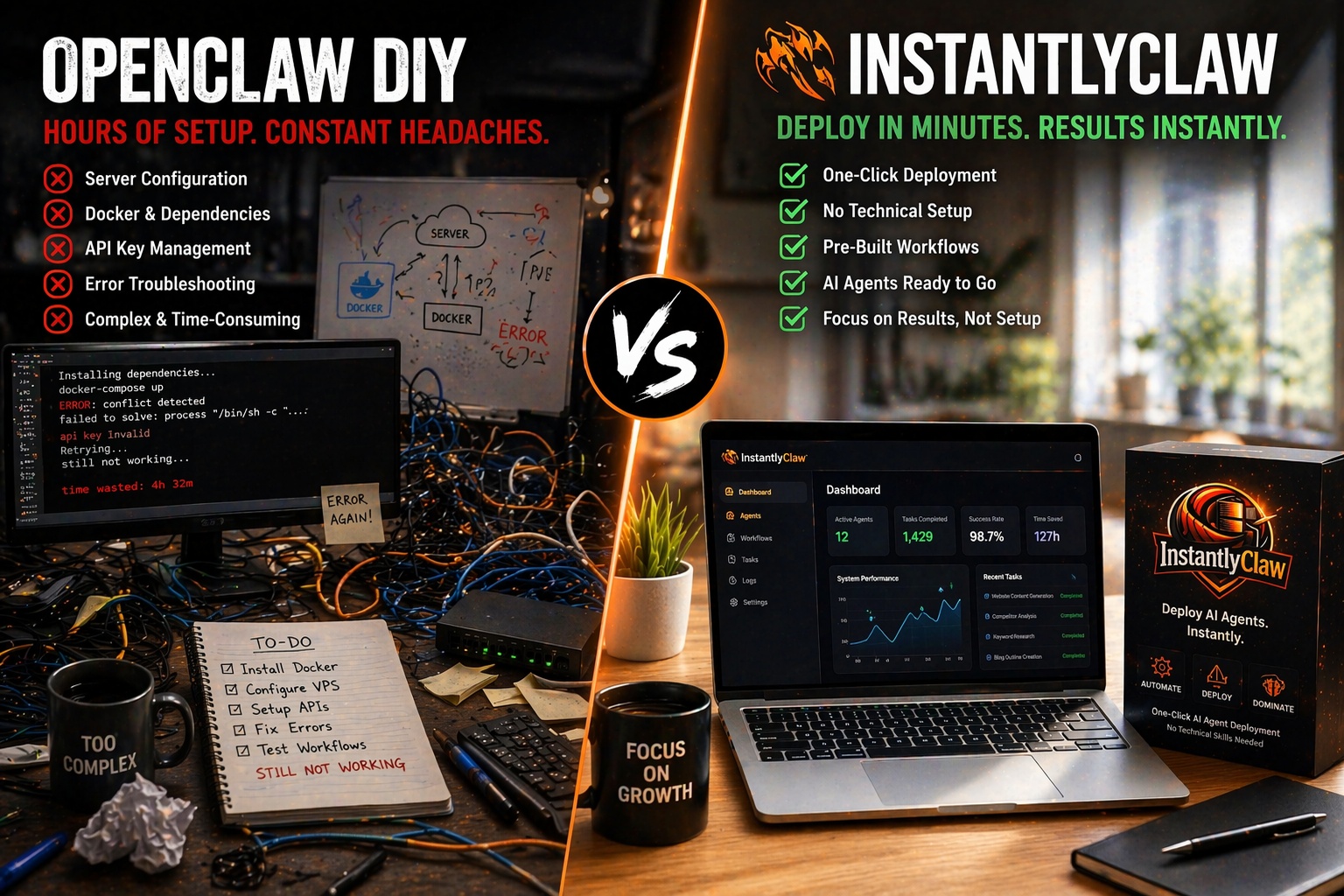
If you’ve explored AI agents recently, you’ve probably come across OpenClaw. It’s powerful, no doubt. However, the moment you try setting it up yourself, the reality hits—Docker, APIs, servers, and constant troubleshooting.
That’s where this InstantlyClaw vs OpenClaw comparison becomes important. The real question isn’t which one is more powerful. It’s which one actually saves you time and gets you results faster.
What is the real difference in InstantlyClaw vs OpenClaw setup time?
In simple terms, the difference comes down to setup vs usage.
With OpenClaw DIY, you spend hours (or even days) setting things up. On the other hand, InstantlyClaw lets you deploy a working system in about a minute.
Here’s what actually matters:
- OpenClaw DIY → Setup first, results later
- InstantlyClaw → Results first, no setup
Therefore, if your goal is speed, the difference is significant.
How much time does OpenClaw DIY actually take to set up?
The key idea is that OpenClaw is not beginner-friendly.
To get it running, you typically need:
- Docker installation and configuration
- API key setup
- VPS or hosting environment
- Debugging errors and dependencies
However, even after all that, things may not work perfectly.
As a result, many users spend more time fixing issues than actually using the system.
How does InstantlyClaw eliminate setup time completely?
This is where InstantlyClaw changes the experience.
Instead of building everything manually, you:
- Log in
- Click deploy
- Start using the system
That’s it.
This InstantlyClaw vs OpenClaw comparison shows that InstantlyClaw removes the entire setup layer. Therefore, you move directly to execution.
What happens after setup in InstantlyClaw vs OpenClaw?
OpenClaw DIY
After setup, you still need to:
- Test workflows
- Fix errors
- Optimize configurations
InstantlyClaw
After deployment, you:
- Start assigning tasks immediately
- Receive structured outputs
- Use ready-made workflows
In other words, InstantlyClaw is designed for usage, not experimentation.
Which option is better for beginners in InstantlyClaw vs OpenClaw?
For beginners, the answer is straightforward.
OpenClaw DIY can feel overwhelming because it requires technical knowledge. Therefore, most beginners either quit or get stuck early.
InstantlyClaw, however, is built for non-technical users.
You don’t need:
- Coding skills
- Prompt engineering
- Infrastructure knowledge
Instead, you interact with it like a team member.
Can advanced users still benefit from InstantlyClaw?
Yes, and this is often overlooked.
Even experienced users choose InstantlyClaw because:
- It saves time
- It reduces friction
- It speeds up execution
However, if someone wants full control and customization, DIY may still be preferred.
That said, for most practical use cases, speed matters more than control.
What are the real-world implications of this time difference?
Let’s make this practical.
With OpenClaw DIY:
- You might spend days setting up
With InstantlyClaw:
- You can start generating outputs the same day
Therefore, the opportunity cost is huge.
For example:
- A freelancer can deliver work faster
- A marketer can launch campaigns sooner
- An agency can scale operations quickly
If you want to see how this plays out step by step, you can explore a detailed InstantlyClaw walkthrough that shows the exact process.
Final verdict: InstantlyClaw vs OpenClaw – which saves more time?
This InstantlyClaw vs OpenClaw comparison makes one thing clear.
OpenClaw is powerful, but time-consuming. InstantlyClaw, on the other hand, is built for speed and usability.
If your goal is to experiment, DIY might work. However, if your goal is to execute and get results quickly, InstantlyClaw is the better choice.
If you want to see how this compares in terms of features, pricing, and real-world usage, you can check the complete InstantlyClaw review for a deeper breakdown.
Or you can explore the official platform to understand how quickly you can get started.