
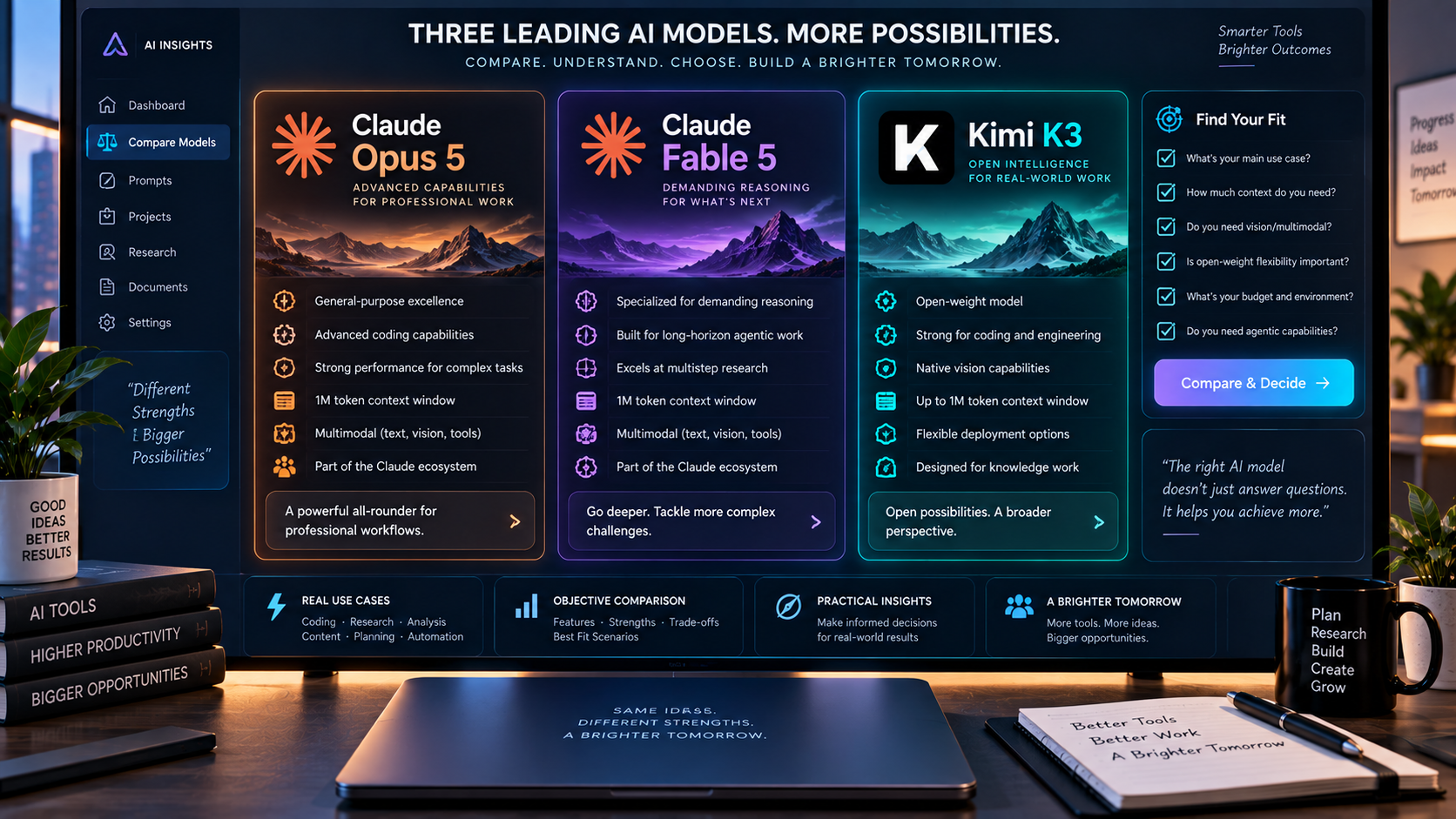
The real difference is simple: Claude Opus 5 is the high-end general-purpose Claude choice, Claude Fable 5 is positioned around demanding AI workflows, and Kimi K3 stands apart with its open-weight architecture, native vision and 1-million-token context. Opus 5 emphasizes advanced coding and knowledge work, Fable 5.1 focuses on demanding reasoning and long-horizon agentic tasks, while Kimi K3 is designed for software engineering, deep reasoning and knowledge work with a 2.8-trillion-parameter MoE architecture. If you want to explore a business-focused way to apply advanced Claude capabilities, check out Fable Fox AI.
These models overlap in capability, but they are not identical products. The most useful comparison is therefore not simply “which AI is smartest?” but rather what each model is optimized to do, how much it costs, how flexible it is, and which type of workflow it fits best.
Claude Opus 5 vs Fable 5 vs Kimi K3: Key Differences
| Feature | Claude Opus 5 | Claude Fable 5.1 | Kimi K3 |
|---|---|---|---|
| Primary focus | Advanced coding and knowledge work | Demanding reasoning and long-horizon agents | Reasoning, coding and knowledge work |
| Context window | 1M tokens | 1M tokens | 1M tokens |
| Maximum output | 128K tokens | 128K tokens | Model/API dependent |
| API input price | $5 / million tokens | $10 / million tokens | $3 / million tokens |
| API output price | $25 / million tokens | $50 / million tokens | $15 / million tokens |
| Vision | Yes | Yes | Native vision |
| Open-weight | No | No | Yes |
Anthropic lists Opus 5 at $5 per million input tokens and $25 per million output tokens, while Fable 5.1 is priced at $10 and $50. Kimi’s official API platform lists K3 at $3 per million input tokens and $15 per million output tokens. All three are associated with a 1-million-token context capability. ([Anthropic](https://platform.claude.com/docs/en/about-claude/pricing?utm_source=chatgpt.com)) ([Kimi](https://platform.kimi.ai/?utm_source=chatgpt.com))
What Is Claude Opus 5 Best At?
Claude Opus 5 is positioned as a powerful general-purpose model for sophisticated professional workloads, particularly software engineering and knowledge work.
For developers, researchers, writers and businesses that want a high-end Claude model without automatically moving to the more expensive Fable tier, Opus 5 provides a strong middle ground.
Its 1-million-token context window is also significant for large projects involving extensive documents, codebases or other substantial inputs.
What Makes Claude Fable 5.1 Different?
Fable 5.1 is specifically designed for demanding reasoning and long-horizon agentic work.
Anthropic highlights long-running agentic coding, multistep research and workflows involving documents, spreadsheets and slides. Fable 5.1 also uses adaptive thinking with a default high-effort setting. ([Anthropic](https://platform.claude.com/docs/en/models/fable-5-1/overview?utm_source=chatgpt.com))
This makes Fable particularly relevant when the AI needs to perform a sequence of connected tasks rather than simply answer one question. A complex research agent, autonomous coding workflow or extended document-analysis project is closer to Fable’s intended use case.
What Makes Kimi K3 Different?
Kimi K3 takes a different approach from the proprietary Claude models.
Moonshot AI describes K3 as its flagship model for frontier intelligence scenarios including software engineering, knowledge work and deep reasoning. Its official platform lists a 1-million-token context window, while K3 is also notable for its open-weight availability and native vision capabilities. ([Kimi](https://platform.kimi.ai/?utm_source=chatgpt.com))
K3 uses a 2.8-trillion-parameter mixture-of-experts architecture, with approximately 104 billion parameters activated per token according to NVIDIA’s model card. That architecture gives developers another option when model flexibility and open-weight access matter. ([NVIDIA](https://build.nvidia.com/moonshotai/kimi-k3/modelcard?utm_source=chatgpt.com))
Which Model Offers the Best Price-to-Capability Balance?
Published API pricing creates a clear numerical difference. Kimi K3 is listed at $3 per million input tokens and $15 per million output tokens, compared with $5/$25 for Opus 5 and $10/$50 for Fable 5.1. ([Kimi](https://platform.kimi.ai/?utm_source=chatgpt.com)) ([Anthropic](https://platform.claude.com/docs/en/about-claude/pricing?utm_source=chatgpt.com))
However, price alone does not determine value. Developers should also consider model quality for their particular prompts, infrastructure requirements, tool support, reliability and how much human supervision their workflow requires.
If you want a broader comparison covering these models and the business applications surrounding them, see the complete Claude Fable 5 vs Opus 5 vs Kimi K3 comparison.
Which Model Is Best for Coding?
All three target serious coding workloads, but they emphasize different strengths.
Opus 5 is a strong choice for advanced interactive development and knowledge work. Fable 5.1 is particularly relevant when coding becomes a long-running autonomous workflow. Kimi K3 is attractive when developers also value open-weight access, native vision and flexibility around deployment.
The practical choice depends on whether your priority is Claude’s proprietary ecosystem, extended agentic reasoning or greater model-level flexibility.
Which Model Is Best for Research?
Fable 5.1 has the clearest documented specialization for multistep research and long-horizon reasoning. Opus 5 is well suited to general research and knowledge work, while Kimi K3 is designed for deep reasoning and knowledge-work scenarios.
For large research projects, the 1-million-token context capability across these models can be useful, but context size should not be confused with reasoning quality. The workflow and model behavior matter just as much.
Watch the discussion: Explore Claude Fable 5, Opus 5 and the wider AI opportunities emerging around today’s advanced models.
Where Does Fable Fox AI Fit?
Fable Fox AI is separate from Claude Opus, Claude Fable and Kimi K3. Its product positioning centers on using advanced Claude capabilities to generate business assets from information about a business, with freelancers, agencies, solopreneurs and content creators among its intended audiences.
That makes it relevant for people who are not simply comparing AI models for personal productivity but are also exploring how AI capabilities can be packaged into business workflows and potential client services.
Frequently Asked Questions
Is Claude Fable 5 better than Opus 5?
Fable 5.1 is specialized for demanding reasoning and long-horizon agentic work, while Opus 5 is positioned as a high-end general-purpose model. The appropriate choice depends on the workload.
Is Kimi K3 cheaper than Claude Fable 5?
Yes, based on current published API rates. K3 is listed at $3/$15 per million input/output tokens, while Fable 5.1 is $10/$50. ([Kimi](https://platform.kimi.ai/?utm_source=chatgpt.com)) ([Anthropic](https://platform.claude.com/docs/en/about-claude/pricing?utm_source=chatgpt.com))
Does Kimi K3 have a 1-million-token context window?
Yes. Kimi’s official platform currently lists a 1-million-token context window for K3. ([Kimi](https://platform.kimi.ai/?utm_source=chatgpt.com))
Which model is best for long-running AI agents?
Fable 5.1 has the clearest documented focus on long-horizon agentic work. K3 and Opus 5 also target advanced coding and knowledge-work scenarios, but their positioning differs.
Final Answer: What Are the Real Differences?
Opus 5 is the high-end general-purpose Claude option, Fable 5.1 is the specialized choice for demanding long-horizon reasoning, and Kimi K3 is the open-weight alternative with native vision and lower published API pricing.
If your priority is advanced Claude-based coding and knowledge work, Opus 5 is directly relevant. If your workload requires sustained reasoning and autonomous multi-step execution, Fable 5.1 is designed around that requirement. If open-weight flexibility, native vision and lower published API costs are important, Kimi K3 brings a substantially different proposition.
The best way to choose is to evaluate the models against your actual workload rather than relying on a single benchmark or headline specification. For the complete comparison and broader business context, visit the Claude Fable 5 vs Opus 5 vs Kimi K3 comparison.