
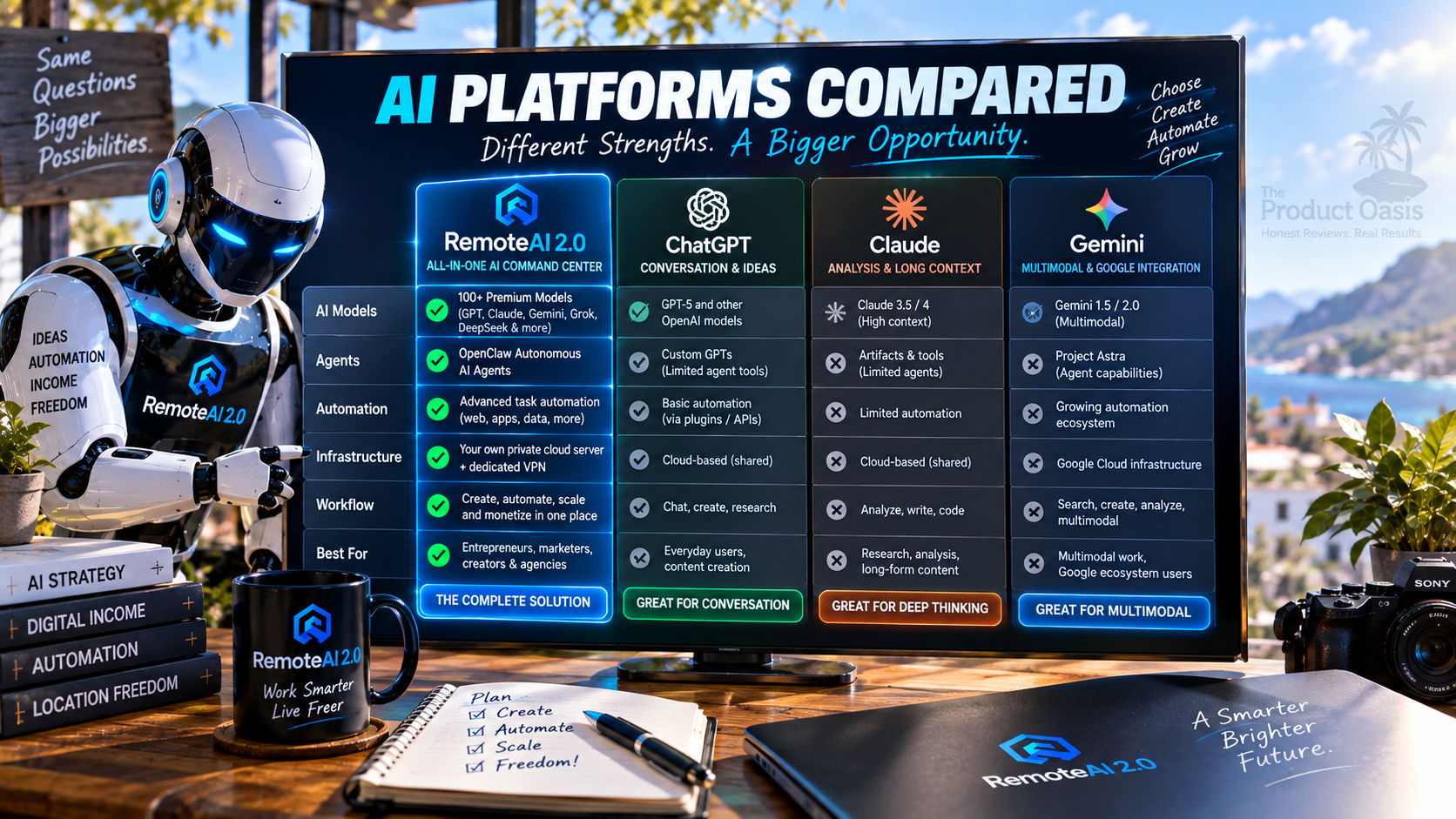
If you’re comparing RemoteAI 2.0 vs ChatGPT, Claude and Gemini, the biggest difference is not simply which AI model gives the best answer. The more important question is how the tools are packaged: standalone AI assistants, or an AI automation environment designed to connect multiple models, agents, workflows and cloud infrastructure in one place.
RemoteAI 2.0 vs ChatGPT, Claude and Gemini: The Short Answer
ChatGPT, Claude and Gemini are primarily AI assistant platforms built around their respective ecosystems and model families. RemoteAI 2.0 takes a different approach by positioning itself as an OpenClaw-powered automation platform with a private cloud-based “Ghost Server,” access to 100+ AI models, persistent memory, VPN infrastructure and autonomous workflows. Those RemoteAI capabilities are vendor claims and should be verified against the current offer and implementation before purchase. :contentReference[oaicite:0]{index=0}
| Category | RemoteAI 2.0 | ChatGPT | Claude | Gemini |
|---|---|---|---|---|
| Primary positioning | AI automation platform built around OpenClaw | General-purpose AI assistant and productivity platform | AI assistant focused heavily on reasoning, coding and professional work | Google’s AI assistant and productivity ecosystem |
| Model approach | Vendor says 100+ AI models are available through its AI Vault | Multiple OpenAI models depending on plan and availability | Claude model family | Gemini model family |
| Autonomous workflows | Core selling point through OpenClaw | Available through selected agentic tools and features depending on plan | Agentic capabilities available through Claude and Claude Code | Increasingly agentic, including proactive and multi-step capabilities |
| Multi-model environment | Yes, according to vendor materials | Primarily OpenAI’s model ecosystem | Primarily Anthropic’s model ecosystem | Primarily Google’s Gemini ecosystem |
| Private server positioning | Dedicated cloud “Ghost Server” claimed by vendor | Hosted by OpenAI | Hosted by Anthropic | Hosted by Google |
| Long-running automation | Central part of the OpenClaw positioning | Depends on the specific ChatGPT feature, plan and workflow | Agentic tools can handle extended tasks, especially for coding | Gemini is expanding into more proactive and agentic workflows |
| Best fit | Users wanting multiple AI models plus automation infrastructure | General-purpose AI, research, writing and productivity | Writing, coding, reasoning and professional workflows | Google-centric research, productivity and multimodal workflows |
What Makes RemoteAI 2.0 Different?
The fundamental distinction is that RemoteAI 2.0 is marketed as an orchestration and automation layer rather than simply another chatbot.
According to the supplied RemoteAI product material, the platform combines a private “Ghost Server,” OpenClaw, a dedicated VPN, persistent long-term memory and access to more than 100 AI models. The vendor also says the system can handle tasks such as website creation, marketing content, graphics, coding, applications, social media workflows and other automated activities. :contentReference[oaicite:1]{index=1}
That matters because the user experience can be fundamentally different. With a conventional AI assistant, you typically open the assistant, describe what you want and receive an answer or generated asset. RemoteAI’s pitch is closer to: give the system an objective, let OpenClaw coordinate the work, and allow the underlying AI models to perform parts of the workflow.
RemoteAI 2.0 vs ChatGPT
ChatGPT has evolved well beyond basic chat. OpenAI currently describes ChatGPT as a general-purpose assistant capable of reasoning, writing, translation, image generation, file analysis, web search, deep research, projects and other tools depending on the user’s plan. Projects can keep chats, files and instructions together for longer-running work. :contentReference[oaicite:2]{index=2}
ChatGPT also has increasingly sophisticated research and workflow capabilities. Its Deep Research feature can research across online sources, work with uploaded files and produce structured reports with citations, while ChatGPT apps can connect conversations with external tools and data. :contentReference[oaicite:3]{index=3}
The difference is therefore less about whether ChatGPT can perform sophisticated tasks—it clearly can—and more about the architecture and positioning.
- ChatGPT: excellent choice if you primarily want a polished AI assistant and OpenAI ecosystem.
- RemoteAI 2.0: potentially more interesting if you specifically want a multi-model automation environment built around OpenClaw and the vendor’s private-server infrastructure.
RemoteAI 2.0 vs Claude
Claude is particularly strong in professional knowledge work, coding and long-running agentic workflows. Anthropic’s current product development includes Claude Code and increasingly capable models designed for coding and professional work. :contentReference[oaicite:4]{index=4}
Claude also has Artifacts, which allow users to create standalone apps, tools, visualizations and other substantial pieces of content that can be edited and reused outside the normal conversation flow. :contentReference[oaicite:5]{index=5}
RemoteAI’s distinction is that Claude would potentially be one model or capability inside a broader multi-model environment, rather than the entire environment itself. The RemoteAI product material specifically lists Claude among the premium models included in its AI Vault. :contentReference[oaicite:6]{index=6}
That creates an important strategic difference:
- If you want the best experience centered around the Claude ecosystem, Claude may be the simpler choice.
- If you want to experiment with Claude alongside multiple other models and an OpenClaw automation layer, RemoteAI 2.0 has a different proposition.
RemoteAI 2.0 vs Gemini
Gemini has also moved substantially beyond simple question-and-answer interactions. Google’s current Gemini ecosystem includes Deep Research, Canvas, Gems, connected services and increasingly agentic features. Gemini Deep Research can use Google Search by default and can incorporate sources such as Gmail, Drive, uploaded files and NotebookLM notebooks when available. :contentReference[oaicite:7]{index=7}
Gemini’s Canvas can also be used to create or edit documents, apps, slides and code, while Gems allow users to customize Gemini for recurring tasks or specialized instructions. :contentReference[oaicite:8]{index=8}
Google has additionally been pushing Gemini toward more proactive assistance. In May 2026, Google announced Gemini features designed around more agentic and proactive help, including Gemini Spark. :contentReference[oaicite:9]{index=9}
So again, RemoteAI isn’t necessarily competing with Gemini simply on “AI quality.” Its proposed advantage is the combination of multiple models, OpenClaw automation and dedicated infrastructure.
The Biggest Difference: One AI Ecosystem vs Multi-Model Orchestration
This is probably the most important distinction to understand before choosing between these platforms.
ChatGPT, Claude and Gemini each give you access to powerful AI capabilities within their respective ecosystems. RemoteAI’s sales proposition is different: rather than forcing you to choose one model for everything, its AI Vault is designed to bring numerous models into a single environment. The supplied product material specifically lists models from OpenAI, Anthropic, Google, xAI, DeepSeek, Meta and image-generation platforms. :contentReference[oaicite:10]{index=10}
In theory, that could reduce the need to jump between different AI interfaces. However, claims about exactly which models, configurations, usage limits and access levels are included can change, so those details should be confirmed at checkout and inside the current RemoteAI account.
If you’re evaluating the purchase primarily on cost and access, it is also worth looking at the current pricing information before making a decision. See the RemoteAI 2.0 pricing breakdown here.
How OpenClaw Changes the Comparison
OpenClaw is an important part of why RemoteAI is positioned differently. OpenClaw itself is a self-hosted gateway designed to connect messaging channels with AI coding agents and supports tools, sessions, memory and multi-agent routing. :contentReference[oaicite:11]{index=11}
Its multi-agent architecture can run multiple isolated agents within one Gateway, with separate workspaces, state and session histories. It can also route different channels or accounts to different agents. :contentReference[oaicite:12]{index=12}
RemoteAI’s supplied material presents OpenClaw as the autonomous engine sitting behind its “Ghost Server,” with the platform handling the infrastructure so users don’t have to build an OpenClaw environment from scratch. :contentReference[oaicite:13]{index=13}
That creates a useful distinction:
| If your priority is… | The more natural fit may be… |
|---|---|
| General AI conversations and productivity | ChatGPT |
| Professional writing, coding and Claude-focused workflows | Claude |
| Google ecosystem, research and multimodal workflows | Gemini |
| Multiple AI models in one environment | RemoteAI 2.0 |
| OpenClaw-centered automation | RemoteAI 2.0 |
| Building a private/self-hosted agent infrastructure yourself | OpenClaw directly |
Does RemoteAI 2.0 Replace ChatGPT, Claude and Gemini?
Not necessarily. That is an important distinction.
RemoteAI’s vendor materials position it as a way to consolidate access to multiple AI models, including ChatGPT-, Claude- and Gemini-related models. :contentReference[oaicite:14]{index=14} But that does not automatically mean it provides an identical user experience, feature set, integrations, account-level benefits or usage limits to subscribing directly to each individual provider.
For example, ChatGPT has its own Projects, apps, deep research and other OpenAI-specific functionality. :contentReference[oaicite:15]{index=15} Gemini has Google-specific integrations and research capabilities. :contentReference[oaicite:16]{index=16} Claude has its own ecosystem, including Artifacts and Claude Code. :contentReference[oaicite:17]{index=17}
Therefore, the smarter comparison is not “Which one has the best AI?” It is “Which environment best matches the way I want to work?”
Who Should Consider RemoteAI 2.0?
RemoteAI 2.0 may make the most sense for users who want to experiment with multiple models without constantly switching between separate AI platforms, particularly marketers, entrepreneurs, developers, creators and automation-focused users.
The vendor also positions the platform for commercial use, claiming that the included commercial license allows users to sell services and products created with the system. :contentReference[oaicite:18]{index=18} As always, users should read the actual license terms rather than relying solely on promotional descriptions.
- AI power users: useful if you want access to multiple model families.
- Marketers: potentially useful for content, websites, funnels and repetitive marketing workflows.
- Developers: potentially useful when different models can be brought into an automated workflow.
- Entrepreneurs: appealing if the goal is to build repeatable AI-assisted business processes.
- Automation enthusiasts: especially relevant if OpenClaw is the main reason you’re interested.
Who May Prefer ChatGPT, Claude or Gemini?
You may not need RemoteAI if your workflow is already working well inside one of the major AI ecosystems.
- Choose ChatGPT if you value OpenAI’s integrated assistant, research, projects and broader tool ecosystem.
- Choose Claude if your work is heavily focused on Claude’s writing, coding, artifacts or agentic capabilities.
- Choose Gemini if Google Search, Google Workspace, NotebookLM and Google’s broader ecosystem are central to your workflow.
- Consider RemoteAI 2.0 if your priority is combining multiple AI models with OpenClaw-based automation and the vendor’s hosted infrastructure.
RemoteAI 2.0 vs ChatGPT, Claude and Gemini: Final Verdict
RemoteAI 2.0 is best understood as a different category of proposition, rather than simply another competitor to ChatGPT, Claude or Gemini.
ChatGPT, Claude and Gemini are mature AI ecosystems with their own models, tools and integrations. RemoteAI 2.0 attempts to put multiple AI models behind an OpenClaw-powered automation layer, combined with a cloud-based private “Ghost Server,” persistent memory and other infrastructure features claimed by the vendor. :contentReference[oaicite:19]{index=19}
That makes RemoteAI potentially more compelling for someone who wants AI orchestration and automation rather than simply a better chatbot. But if you only need a powerful assistant for writing, research, coding or everyday productivity, one of the established platforms may already provide everything you need.
The key is to compare the actual workflow you need—not just model names or marketing claims.
Read the RemoteAI 2.0 pricing breakdown and compare the current offer before deciding.